Camillus, New York · Onondaga County
Concrete Driveway Installation in Camillus, NY | Replacement & New Driveways
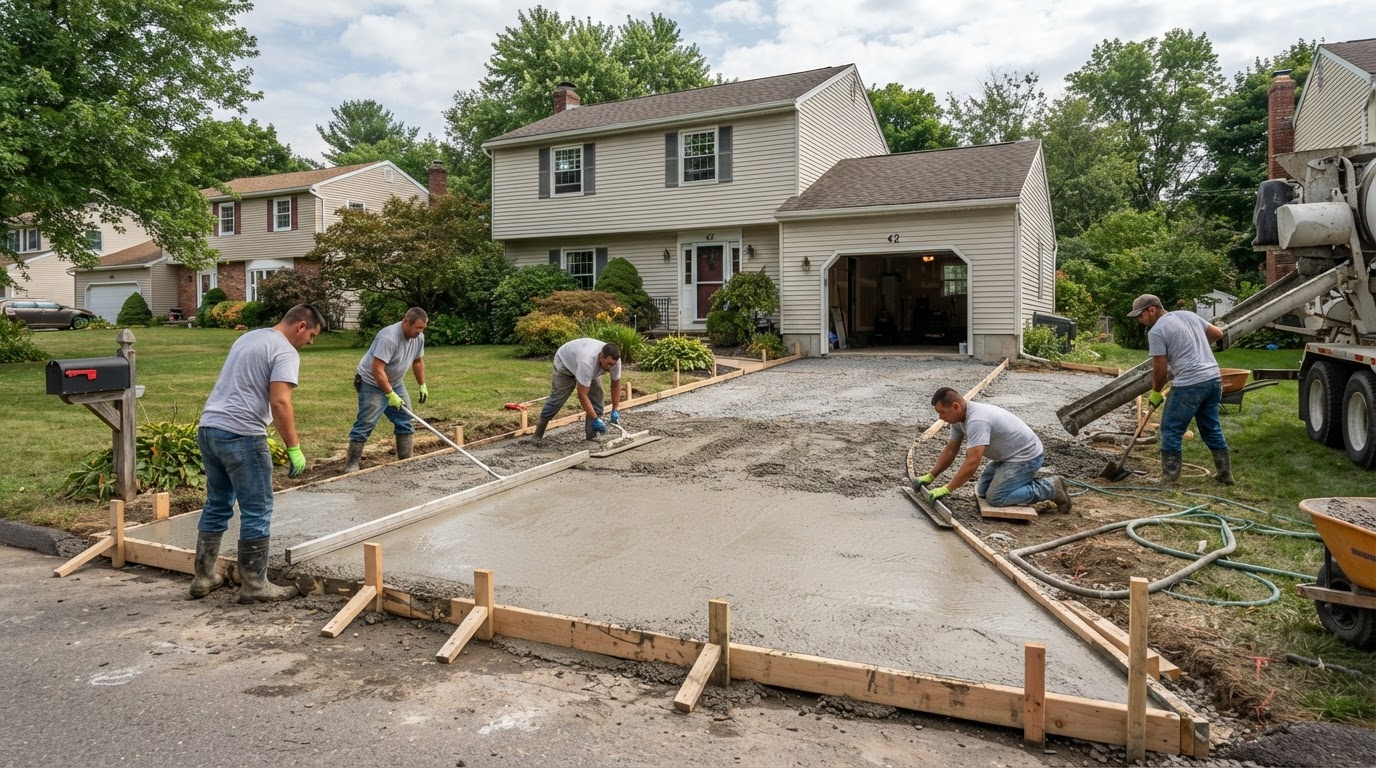
Camillus Concrete Contractor installs and replaces concrete driveways in Camillus and surrounding communities within 25 miles, with 10+ years of concrete experience and insured operations. A durable driveway depends on more than the visible concrete surface — preparation, drainage, appropriate project design, placement, finishing, joints and curing all determine how the driveway holds up over time.
From the Town of Camillus and the West Genesee Street corridor to properties across Onondaga County, exterior concrete in Central New York faces freeze-thaw exposure, winter moisture and deicing-salt exposure. We plan each driveway around the property's grade, access and intended vehicle use, including existing concrete removal, subgrade, base preparation, formwork, reinforcement where project requirements call for it, control joints, a broom finish and adequate curing. We do not promise crack-free concrete — sound construction practices reduce winter-related deterioration, but some cracking is normal as concrete cures and moves.
10+ Years Experience · Insured · Serving Camillus + 25 Miles
Request an Estimate
Get a Concrete Driveway Estimate for Your Camillus Property
Tell us about your driveway project and a team member will reach out to discuss scope, access, grade, drainage and the finish you want. Default service request: Concrete Driveway.
Why Choose Us
Why Choose Camillus Concrete Contractor for a Concrete Driveway in Camillus, NY
A concrete driveway is a long-term investment in property access and curb appeal, and the right preparation matters more than the visible surface. Camillus Concrete Contractor plans each driveway around the property's grade, access and intended use, with 10+ years of concrete experience and insured operations behind the work.
We handle new installation, complete replacement, and site-specific extensions or transitions where the property and applicable jurisdiction allow it, and we state plainly what we can and cannot verify rather than making unsupported superlative claims.
10+ Years of Concrete Experience
Camillus Concrete Contractor brings 10+ years of concrete experience to driveway installation and replacement across the Camillus area. That experience shows in the preparation steps property owners rarely see — base, grade, drainage, joints and curing — rather than a specific job count or founding year we have not verified. Each driveway is planned around the property's access, grade, and intended vehicle use.
Insured Concrete Work
Camillus Concrete Contractor is insured, which is a meaningful hiring consideration for a project that brings demolition, excavation, heavy materials and equipment onto your property. Insured status helps protect against liability for covered incidents during the work. We do not state 'licensed and insured' — only the insurance status we can verify — and we give no carrier name, policy number, or bonding status.
Site-Specific Driveway Planning
A durable driveway starts with planning the project around the driveway's dimensions, access, grade, existing conditions and intended vehicle use. We do not apply one set of dimensions or a single approach to every slab; the driveway design follows the property. Scope and known variables are discussed openly before any pricing or scheduling is finalized.
Base Preparation
The finished slab relies on properly prepared underlying conditions, so the subgrade and compacted stone base are prepared to suit the site before any concrete is placed. We do not invent a universal base depth; base depth and materials depend on soil conditions, drainage, and the project design. A stable, well-compacted base is what gives the driveway its support and reduces uneven settlement.
Drainage and Grade
Drainage direction and the site's slope need evaluation before placement, because water that ponds or runs toward the foundation or garage undermines a driveway over time. Grade is planned so surface water moves where it should, and transitions to the street, walkways and garage are matched to the existing layout. Correct drainage is a project-specific decision, not an afterthought.
Jointing and Finishing
Control joints are placed to manage where normal shrinkage cracking occurs, and a common exterior broom finish provides texture for traction and a durable surface. We do not promise that joints prevent all cracking — concrete naturally moves and some cracking is normal as it cures. Joint layout and finishing are matched to the driveway's size, shape and use rather than applied generically.
Central New York Conditions
Concrete driveways in Central New York face repeated freeze-thaw cycling, winter moisture, and deicing-salt exposure, so preparation, drainage, jointing, placement and curing are planned with those conditions in mind. Air-entrained exterior concrete is a recognized freeze-thaw durability concept; we do not claim a specific supplier or mix as a company standard. Winter exposure is a durability consideration, not a guarantee of failure when concrete is well placed.
Clear Scope and Pricing
Estimates reflect the major factors that influence cost — square footage, demolition, excavation, base correction, access, drainage, reinforcement and finish — and website pricing ranges are labeled as local market guidance, not a guaranteed company price. We state plainly what is included and what could change the total, and we do not claim 'free estimates' unless that is separately verified.
Our Driveway Services
Our Concrete Driveway Services
Driveway projects range from new installation to complete replacement and site-specific extensions or transitions where appropriate. Each scope below follows the same three-part approach: what is done and where, how it is built using named concrete methods and materials, and the outcome the property owner receives.
New Concrete Driveway Installation
New residential concrete driveway installation in Camillus and the surrounding 25-mile service area, built for the property's layout, access and intended vehicle use.
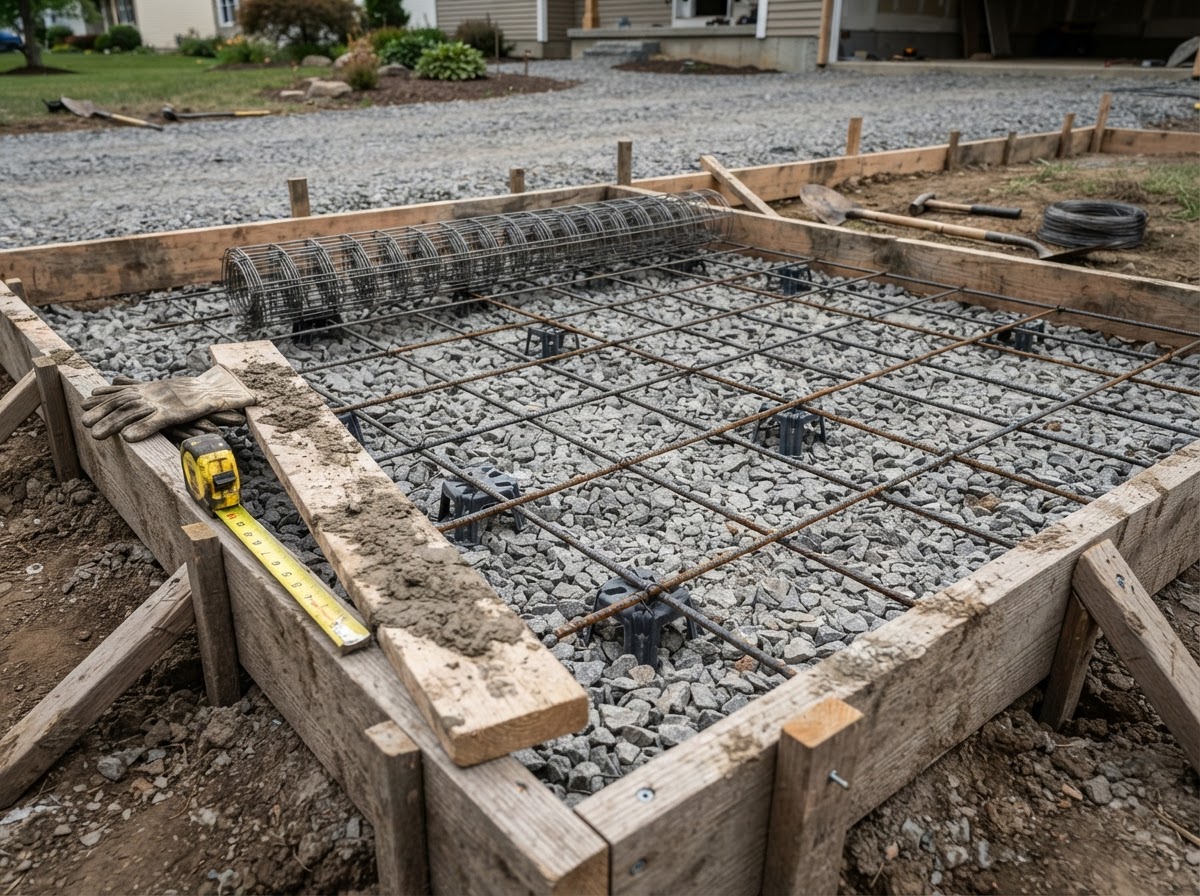
Work includes site evaluation, excavation as needed, subgrade preparation, a compacted aggregate base, formwork, reinforcement where specified, concrete placement, screeding, edging, control joints, a broom finish and curing — with depths and concrete strength set by the project rather than a universal standard.
The outcome is functional vehicle access with grade, drainage, finish and dimensions built around the property and project requirements, rather than a one-size approach applied to every slab.
Concrete Driveway Replacement
Existing driveways with widespread cracking, spalling, settlement or failed sections may be candidates for removal and replacement rather than continued patching.
Replacement work includes demolition, saw cutting where appropriate, haul-off, inspection of underlying conditions, base correction where needed, forms, new concrete placement, joints, finish and curing — addressing the base rather than covering a failing surface.
The outcome is replacing a broadly failed driveway rather than repeatedly patching surface symptoms that may stem from larger slab or base problems, though not every cracked driveway must be replaced.
Driveway Extensions and Concrete Aprons
Driveway additions, widened areas, and concrete apron or transition work in Camillus, built only where the property and applicable jurisdiction allow it.
Work matches elevation and drainage to the existing driveway, handles transitions and existing concrete interfaces, and places isolation joints and control joints where the new pour meets the old — with right-of-way considerations confirmed where applicable.
The outcome is a usable transition or additional paved area integrated with the property's existing driveway layout, rather than an extension performed without checking the property's conditions and jurisdiction.
We do not imply the company performs public-road work, and we do not promise a driveway extension is permit-exempt — permit and right-of-way requirements depend on the specific property and jurisdiction.
Replace vs. Repair
When Should a Concrete Driveway Be Replaced Instead of Repaired?
A concrete driveway is more likely to need replacement when deterioration is widespread, slabs have significant movement or settlement, or underlying conditions make localized repairs unlikely to last. For localized deterioration — a few cracks, a spalled edge, or a single failed section — concrete driveway repair in Camillus may be the better fit. The sections below outline the conditions that tend to push a driveway toward replacement.
Widespread Cracking
There is a difference between an isolated crack and a broad pattern of slab distress. A single hairline crack may be a candidate for localized repair, while map cracking, repeated cracking across multiple slabs, or cracks with vertical movement often point to deeper base or subgrade issues. We do not diagnose a structural cause remotely — a site evaluation determines whether the cracking reflects an underlying problem.
Settlement or Uneven Slabs
Grade and settlement can affect vehicle travel, drainage, and transitions to the street or garage. When slabs have dropped or tilted, resurfacing over the top does not correct the underlying movement, and the uneven surface can create trip hazards and pooling water. Replacement allows the base to be corrected so the new slab rests on stable, properly compacted ground.
Severe Spalling or Surface Breakdown
Freeze-thaw exposure and deicing-salt exposure can contribute to surface scaling and spalling over time, though they are not always the sole cause. When the surface has broken down broadly across the driveway, a thin repair or resurfacing may not bond reliably to the deteriorated substrate. Severe surface breakdown across most of the slab often points toward replacement.
Repeated Repairs That No Longer Address the Problem
Repeated patching can become poor value when deterioration is extensive and the underlying base or drainage has not been corrected. Each patch addresses a symptom while the base, joint or drainage issue that caused it may continue. When repairs no longer hold or the failures keep returning, replacement addresses the root conditions rather than the surface symptoms.
Causes
What Causes Concrete Driveways to Deteriorate in Central New York?
Concrete driveway deterioration can result from a combination of site preparation, drainage, freeze-thaw exposure, deicing salts, settlement, joint performance, age and traffic conditions. Rarely is a single factor the whole story, and a site evaluation helps identify which conditions are driving the deterioration on a specific driveway.
Freeze-Thaw Exposure
Central New York winters cycle concrete through repeated freezing and thawing. When moisture saturates the surface and then freezes, the expansion stresses the concrete, which can contribute to scaling and surface breakdown over time. Proper placement, adequate curing, and the right mix for exterior exposure help concrete resist this cycling. We explain this at a hiring-decision level rather than as a chemistry lesson, and we do not give DIY instructions.
Water and Drainage Problems
Standing water, runoff directed toward the slab, and poor underlying drainage all shorten a driveway's service life. Water that ponds on the surface or saturates the base contributes to scaling, settlement and joint problems. That is why drainage direction and site slope are evaluated before placement, so the finished driveway sheds water where it should rather than trapping it against the slab.
Deicing Salt Exposure
Deicing chemicals can contribute to surface scaling and spalling, particularly on concrete that has not been adequately cured or finished for exterior exposure. Not all salt exposure ruins concrete — properly placed, cured, and jointed exterior concrete generally tolerates typical winter use better than poorly placed concrete. We do not claim all salt exposure causes failure, and we do not give DIY salt-treatment or sealing procedures.
Movement or Base Problems
Underlying movement — settlement, heaving, or an unstable base — often shows at the slab surface as cracking, uneven sections, or joint failures. When the base beneath the driveway has shifted or was not adequately compacted, the concrete on top reflects that movement. Correcting the base is part of replacement, which is why resurfacing over a moving or failed base rarely lasts. We do not prescribe DIY repairs for structural or base problems.
Our Process
Our Concrete Driveway Installation Process
Step 1
Site Evaluation and Project Planning
We assess the driveway dimensions, access, existing concrete condition, grade, drainage and intended vehicle use to define the project scope before any pricing or scheduling is discussed. Transitions to the street, walkways and garage are reviewed so the new driveway fits the property rather than a generic layout.
Step 2
Removal, Excavation and Base Preparation
For a replacement, the existing concrete is demolished and hauled off, with saw cutting where appropriate, and the underlying conditions are inspected. For a new installation, unsuitable material is removed as required and a stable, compacted base is prepared. We do not invent a universal aggregate or base depth; those follow soil, drainage and project conditions.
Step 3
Forms and Project-Appropriate Reinforcement
Formwork is set to the driveway's dimensions and grade, and reinforcement is placed only where the project design and requirements call for it. Options such as rebar, welded wire reinforcement or fibers may be appropriate for specific projects, but not every driveway uses all of these, and the choice follows the project rather than a universal schedule.
Step 4
Concrete Placement, Jointing and Finishing
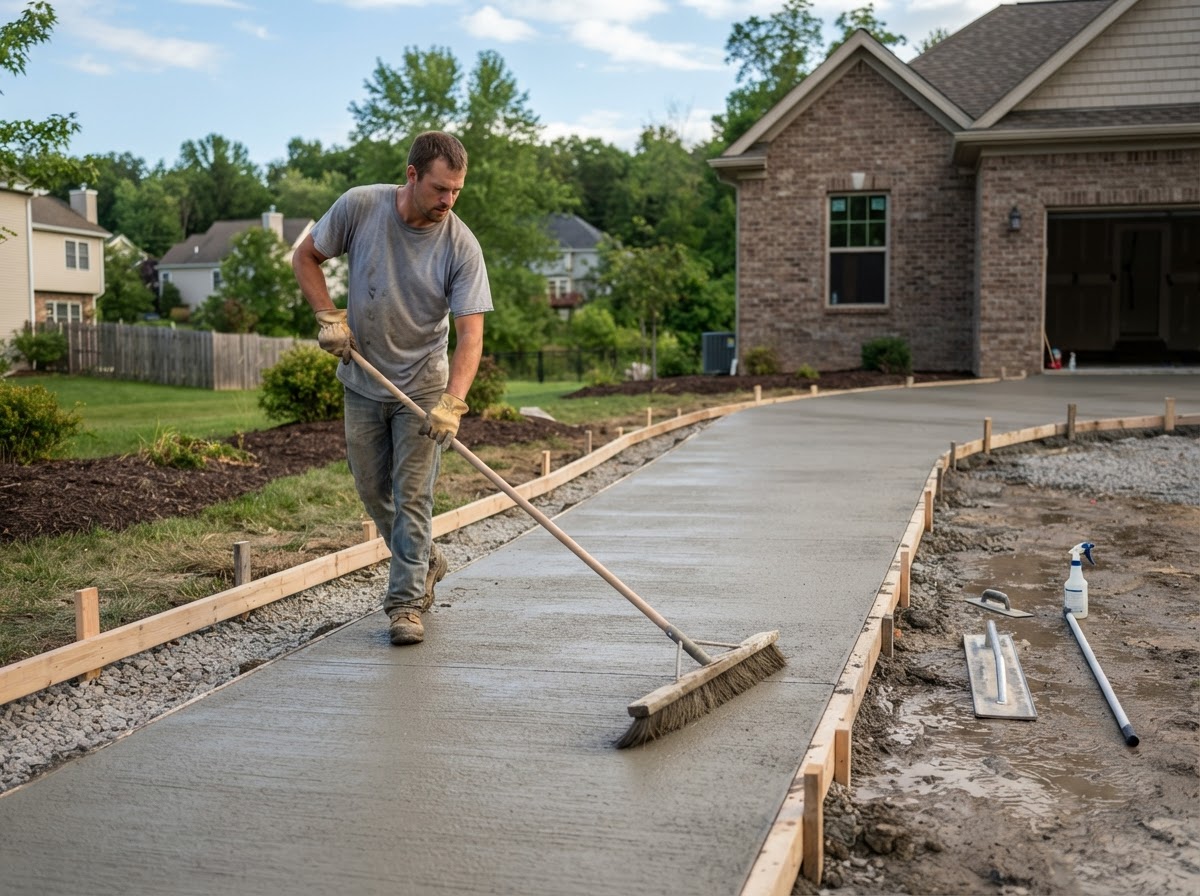
Ready-mix concrete is placed and screeded to grade, then floated, edged and finished — commonly with a broom finish for exterior traction. Control joints are placed to manage where normal shrinkage cracking occurs, and isolation joints separate the driveway from adjacent surfaces and structures at transitions.
Step 5
Curing and Final Site Cleanup
Concrete develops strength over time, so the surface is protected for adequate curing and the site is cleaned of forms and debris. The project-specific instructions govern when pedestrian and vehicle use should resume; we do not give one universal vehicle-use day count, because mix, weather and project conditions change the timing.
Need a New Concrete Driveway in Camillus?
Whether you need a new driveway or a complete replacement, call 315-860-1848 or request an estimate. We'll review the dimensions, existing conditions, access, grade and drainage, then provide project-specific guidance rather than a generic guess.
Call 315-860-1848Pricing Guidance
How Much Does a Concrete Driveway Cost in Camillus, NY?
Concrete driveway installation or replacement in the Camillus/Syracuse area commonly falls around $6–$17 per square foot as a local-market planning range, with demolition, site preparation, drainage, and project requirements affecting the final quote. All figures below are typical Camillus/Syracuse-area market pricing for planning, not a guaranteed company price.
- New Concrete Driveway Installation
- $6–$17 per sq. ft.
- Example 600-Square-Foot Driveway
- Approximately $3,600–$10,200
- Existing Concrete Demolition and Removal
- Often about $3.50–$6 per sq. ft.
- Driveway Repair or Resurfacing
- Approximately $600–$6,000
Project size, site access, grade, base preparation, reinforcement/project design, drainage, finish, and concrete placement conditions influence the total. This is a local-market planning range, not a guaranteed company price.
Planning math from the local per-square-foot range, not a guaranteed quote. Removal of existing pavement or significant site correction can add cost above this range.
For straightforward slab removal. Thickness, reinforcement, machine access, hauling, and disposal conditions affect demolition cost. Complicated removals can run higher.
Comparison guidance only for many localized/resurfacing scopes. Widespread failure may require replacement rather than resurfacing; settlement or base problems can push the project toward full replacement.
See concrete driveway repair in CamillusWhat Changes the Cost of a Concrete Driveway?
- Driveway square footage and overall size
- Existing pavement removal and haul-off
- Excavation and subgrade condition
- Base correction and compacted aggregate preparation
- Site access for trucks and equipment
- Grade, drainage, and transitions to the street or garage
- Reinforcement and project design requirements
- Finish complexity (plain broom vs. decorative)
- Permit or right-of-way requirements where applicable
We do not state invented disposal fees or ready-mix surcharges; concrete disposal and ready-mix costs vary by hauler, site access, and mix requirements specific to the project.
Does a Concrete Driveway in Camillus Need a Permit?
The Town of Camillus currently publishes a driveway permit application for applicable driveway work and lists a $75 driveway permit fee in its current fee materials where that permit applies. Requirements can differ if the property is within another village or city or if the driveway connects to a county or state roadway, so the applicable authority must be confirmed for the specific address. Not every driveway repair triggers a permit. You can review the applicable Town of Camillus driveway and fee information on the town website.
Options & Finishes
Concrete Driveway Options and Finishes
Broom-Finished Concrete Driveways
A broom finish is a common exterior textured finish for residential driveways in Camillus, drawn across the surface after floating to create a light, consistent texture.
The texture provides traction-oriented surface grip for vehicle and foot traffic, with the control joint layout planned for the driveway's size and the finish applied while the concrete is workable. We do not use the term 'slip-proof' — the texture improves grip, but no surface is slip-proof in all conditions.
The outcome is a practical, durable driveway finish suited to Central New York seasonal exposure, with joints placed to manage normal cracking and a texture that holds up to winter use.
Stamped Concrete Driveway Accents
Stamped or decorative concrete can add pattern and color to driveway accents or suitable flatwork in Camillus, applied as a design feature where the project calls for it.
Stamping involves pattern mats, color and release systems pressed into the concrete while it is workable, with sealing applied afterward to protect the decorative surface. Pattern complexity, multiple colors, borders and sealing all affect the look and the cost above a plain broom finish.
The outcome is a decorative surface where suitable; we do not claim full stamped driveways are always recommended, and stamped accents are a design option rather than a default. See our stamped concrete options for more detail.
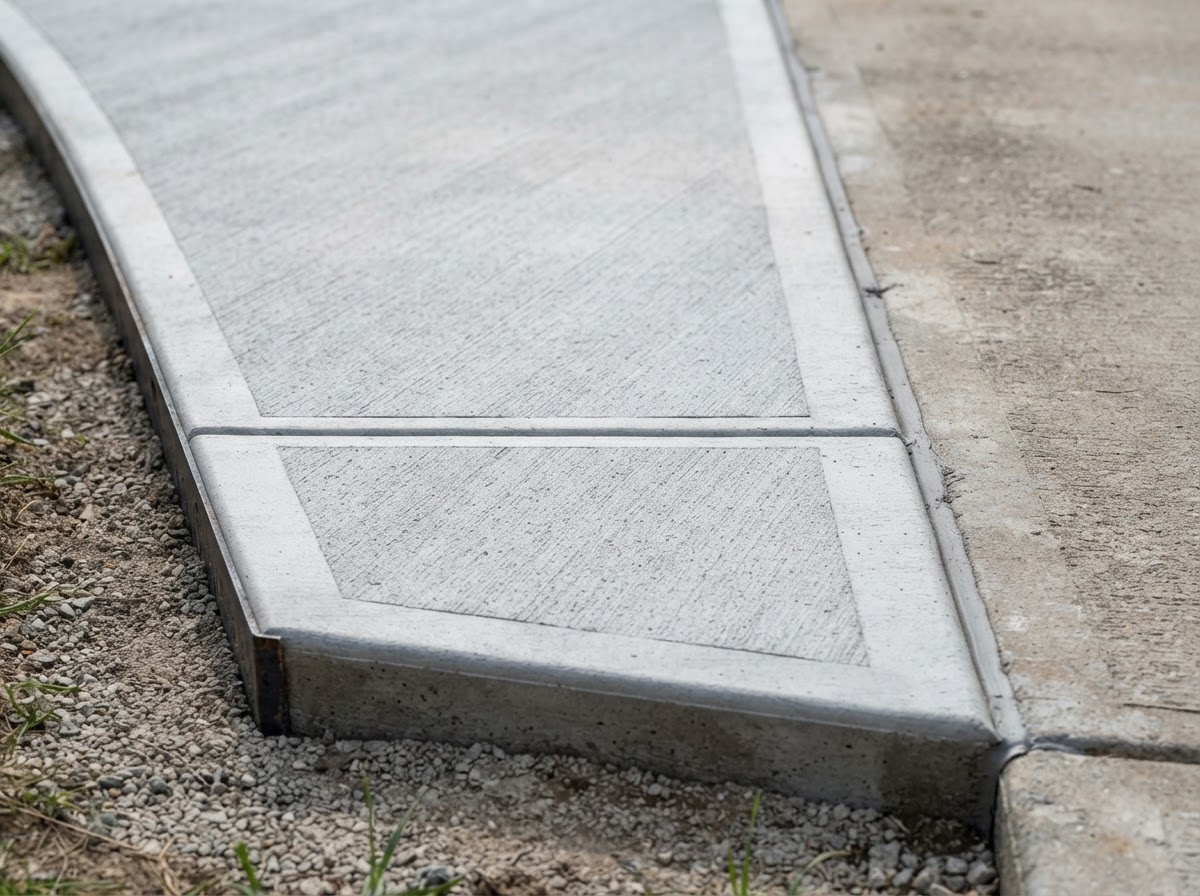
Driveway Replacement With New Concrete
Replacement removes extensively deteriorated existing pavement and places new concrete, correcting the base and drainage rather than covering a failed surface with a thin overlay.
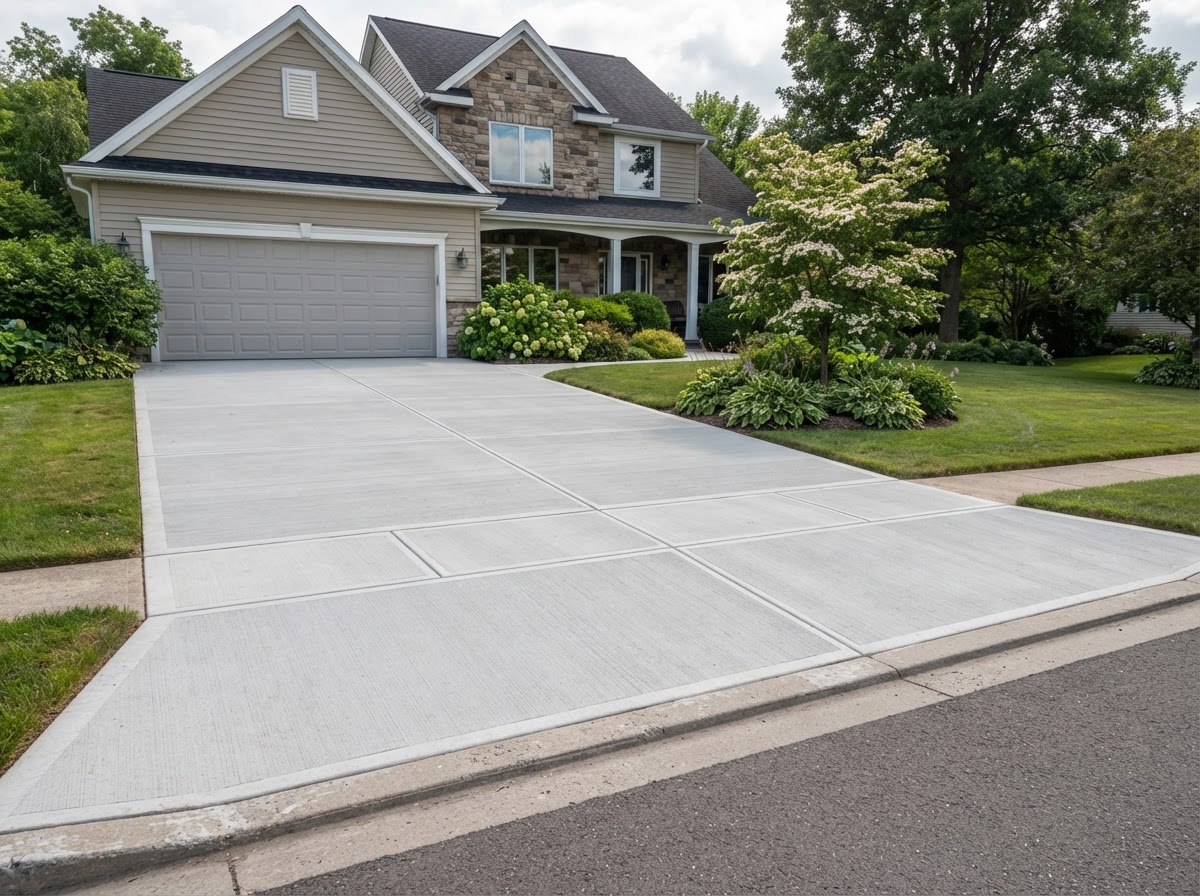
The new slab is finished — commonly with a broom finish — and jointed to manage normal cracking, with transitions to the street, walkways and garage matched to the property's existing layout. Finish and joint design follow the project rather than repeating the earlier replacement scope verbatim.
The outcome is a new driveway built on a corrected base with clean transitions and a durable finish, suited to property owners whose existing driveway has failed beyond practical repair.
Climate
Concrete Driveways and Central New York Weather
Concrete driveways in Central New York must contend with repeated freezing and thawing, winter moisture and deicing exposure, making preparation, drainage, jointing, placement and curing important project considerations. Freeze-thaw cycling stresses exterior concrete when moisture saturates the surface and then freezes, and air-entrained exterior concrete is a recognized freeze-thaw durability concept — though we do not claim a specific supplier or mix as a company standard. Water saturation, surface scaling, spalling, deicing chemicals, snow removal and drainage all factor into how a driveway performs through the seasons.
We do not give DIY salt-treatment or sealing procedures, and we do not claim that sealer guarantees winter protection. Sound base preparation, drainage, proper jointing, adequate finishing and curing all help exterior concrete hold up to Central New York conditions, but no driveway is guaranteed crack-free — some cracking is normal as concrete cures and responds to temperature and moisture changes.
Customer Feedback
What Camillus Customers Say About Our Concrete Driveways
Real customer reviews will appear here once they are supplied. We do not publish fabricated reviews, reviewer names, star ratings or review counts, and no Review or AggregateRating structured data is emitted on this page.
FAQs
Frequently Asked Questions About Concrete Driveways
A concrete driveway in the Camillus/Syracuse area commonly costs about $6–$17 per square foot as a local-market planning range for installation or replacement, so a roughly 600-square-foot driveway often lands near $3,600–$10,200 as planning math. Demolition of an existing driveway, subbase correction, reinforcement, drainage work, thickness and project requirements, and site access can all change the final number materially. Website ranges are local market guidance rather than a guaranteed quote, and the actual price comes from a site-specific estimate after reviewing the property.
A new concrete driveway installation timeline depends on demolition, excavation, site preparation, driveway size, weather, and the project-specific curing schedule, so there is no single universal day count. A straightforward replacement may take a day or two of active placement plus curing time, while a new installation needing excavation and base correction can span several days across preparation, forming, placement and finishing. Curing continues after the crew leaves, and the project-specific schedule governs the actual timeline for your property.
A new concrete driveway should not carry vehicle traffic until the concrete has cured sufficiently for the specific mix, weather, and project conditions, which is why a single universal day count is not safe to state. Concrete continues gaining strength over days and weeks, and loading it too early can damage the surface during the critical early curing period. The contractor's project-specific instructions govern when vehicle use should resume, and those instructions reflect the mix, thickness, weather and intended load for your driveway.
A cracked concrete driveway may be repairable when damage is localized, while widespread cracking, movement, or extensive deterioration can make replacement the better long-term option. Hairline or stable isolated cracks may be suitable for localized repair, but cracks from settlement, base failure, or broad slab distress often point toward replacement rather than repeated patching. A site evaluation determines which approach makes sense for the condition; see our concrete driveway repair options for localized deterioration.
Concrete driveways can crack in Central New York, even when properly installed, because concrete naturally moves and local slabs experience temperature, moisture, and load changes through freeze-thaw cycling and winter conditions. Control joints are planned to manage where normal shrinkage cracking occurs, but joints help manage cracking rather than guarantee zero cracks. Sound base preparation, drainage, proper jointing, finishing and curing all reduce winter-related deterioration, yet some cracking remains normal as concrete cures and responds to its environment.
A concrete driveway's reinforcement needs depend on the driveway design, subgrade conditions, intended loads, and project requirements, so reinforcement is not a one-size decision. Options such as rebar, welded wire reinforcement, or fiber systems may be appropriate for specific projects, but not every driveway uses all of these, and the choice follows the project design and load requirements rather than a universal schedule. The reinforcement approach is determined as part of the project-specific planning for the property.
Some driveway work in the Town of Camillus is subject to the Town's driveway permit requirements, and the current Town fee schedule lists a $75 driveway permit fee where that permit applies. Requirements can differ if the property is within another village or city, or if the driveway connects to a county or state roadway, so the applicable authority must be confirmed for the specific address rather than assumed. Not every driveway repair triggers a permit, and the permit question is resolved for the specific property and project scope.
Request a Concrete Driveway Estimate in Camillus
From new driveway installation to complete replacement, Camillus Concrete Contractor handles concrete driveways across Camillus and a 25-mile service area — backed by 10+ years of concrete experience and insured operations. We provide site-specific evaluation and transparent local-market pricing guidance rather than a generic quote. Call 315-860-1848 or request an estimate below. We do not claim a free estimate, a written warranty, a licensed-contractor status, or guaranteed workmanship — only what we can verify.
See the Camillus concrete contractor home page for the full range of services, related concrete slab work for garages and pads, or the concrete service area page for the communities we serve across the 25-mile radius.
Call 315-860-1848